Data foundations & architecture
How enterprise data is structured, maintained, and represented to support trusted use.

A Sixt Holdings framework
AI capability alone does not create organizational intelligence. Organizations also need the infrastructure, data, knowledge representations, semantics, governance, processes, and human context required to transform information into meaningful action.
Developed by Sixt Holdings, CIMM provides a structured framework for assessing that foundation.
About CIMM
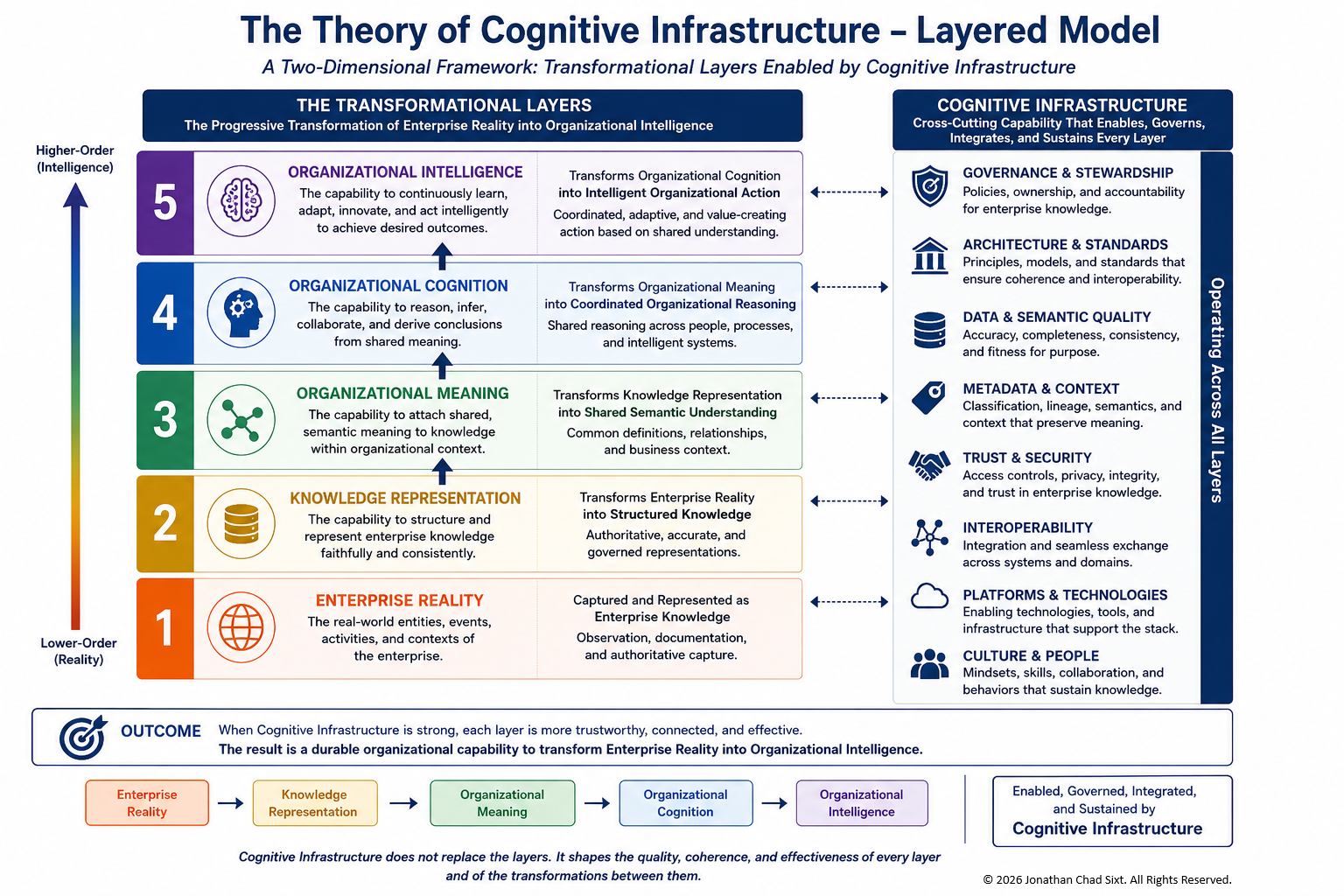
The Cognitive Infrastructure Maturity Model is a framework developed by Sixt Holdings from Dr. Sixt's Theory of Cognitive Infrastructure to help organizations evaluate how effectively their technical and organizational infrastructure represents reality, preserves meaning, supports reasoning, and enables increasingly capable AI and human decision making.
Core concept
Why CIMM exists
Many organizations invest in AI while foundational constraints remain unresolved. Fragmented data, poor lineage, inconsistent semantics, and disconnected systems make it difficult to establish authoritative representations of enterprise reality.
Legacy infrastructure, tightly coupled business logic, weak knowledge representation, and limited governance can further restrict how information is understood, shared, and used.
AI systems reasoning over incomplete or misleading representations may carry those limitations into their outputs. Increasingly capable AI makes the quality of its underlying infrastructure more consequential.
CIMM helps organizations examine these foundations alongside their AI ambitions and identify where improvement is needed.
Assessment scope
The framework considers the foundations that connect enterprise information to reliable reasoning and action.
How enterprise data is structured, maintained, and represented to support trusted use.
How systems exchange information and support connected workflows across organizational boundaries.
Ownership, authoritative sources, provenance, and controls that support confidence in information.
Shared semantics, definitions, and knowledge representations that preserve context for people and systems.
How responsibilities, human context, and operating practices support the use of information in decisions.
The ability to connect foundational capabilities to AI, analytics, and the operational use of intelligence.
Maturity perspective
Organizations can strengthen their Cognitive Infrastructure over time, moving from fragmented and reactive environments toward more integrated, governed, contextualized, and cognitively capable environments.
Disconnected information and manual coordination limit shared understanding.
Connected representations, shared meaning, and accountable practices support more capable reasoning and action.
Business value
CIMM can help organizations identify gaps and establish priorities for strengthening the infrastructure behind AI and organizational intelligence. Potential outcomes include:
Work with Sixt Holdings
Engagements can focus on an initial view of readiness or a deeper examination of the foundations shaping organizational capability.
A high-level evaluation of organizational readiness and Cognitive Infrastructure.
A deeper assessment of technical, data, organizational, and semantic maturity.
A collaborative engagement involving organizational stakeholders.
A focused engagement to develop priorities and a roadmap for improving foundational capabilities.
For a starting point, try the AI Readiness Analyzer. This browser-based tool is a conversation starter, not a formal CIMM assessment.
Understand where your organization is today, identify the gaps limiting AI effectiveness, and establish a roadmap toward stronger organizational intelligence.